
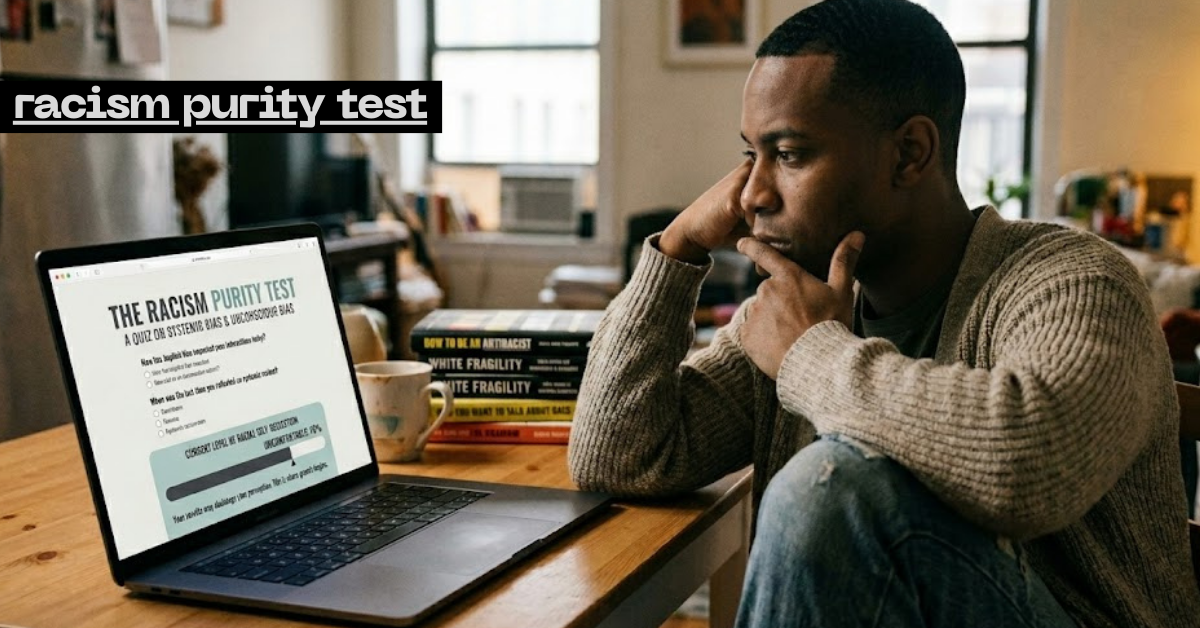
It started as a joke.
One evening, I was scrolling through social media when I saw someone mention a “racism purity test.” The comments were intense. Some people were laughing about their scores. Others were arguing. A few were genuinely reflecting.
Curiosity got the best of me.
I clicked.
What I expected was a silly internet quiz. What I got instead was an uncomfortable mirror.
And honestly? I’m glad I took it.
In this post, I want to share my personal experience with a racism purity test, what it revealed about me, and why these online tests can spark meaningful conversations—if we approach them the right way.
What Is a Racism Purity Test, Really?
Before I took it, I assumed it would be extreme. Maybe accusatory. Maybe dramatic.
But the racism purity test I encountered was more like a self-reflection tool. It asked questions about:
-
Personal biases
-
Cultural exposure
-
Stereotypes I’ve heard or believed
-
My reactions to diversity
-
My behavior in uncomfortable social situations
It wasn’t about labeling someone as “good” or “bad.” It was about awareness.
That’s an important distinction.
A lot of people confuse these kinds of tests with something judgmental. But in reality, many are designed to spark conversations about unconscious bias, racial sensitivity, and personal growth.
And trust me—some of those questions hit harder than I expected.
The Moment I Paused Mid-Test
About halfway through the racism purity test, I found myself staring at a question longer than I wanted to.
It wasn’t offensive. It wasn’t aggressive.
It was simple.
It asked whether I had ever laughed at a stereotype-based joke.
I wanted to say no immediately. That’s the “right” answer, right?
But then I remembered situations from years ago. School. Gatherings. Casual comments I didn’t challenge. Times when I stayed quiet.
And that pause? That’s when I realized the test was working.
Not because it was shaming me.
But because it made me think.
Why These Tests Can Be Useful (If You Use Them Correctly)
Let’s be honest. Internet quizzes can be silly. Some are purely for entertainment.
But a racism purity test, when taken seriously, can do three powerful things:
Increase Self-Awareness
We all have blind spots. I do. You do. Everyone does.
Sometimes we don’t realize how certain jokes, assumptions, or habits reflect internalized bias.
Self-awareness is the first step toward growth.
Start Honest Conversations
After I finished the test, I sent it to two friends.
Instead of comparing scores competitively, we talked about the questions.
That discussion was more valuable than the test itself.
Encourage Accountability
No one is “pure.” That’s unrealistic.
But asking ourselves tough questions builds racial awareness and social responsibility.
It moves the conversation from denial to reflection.
My Personal Takeaways from the Racism Purity Test
Here’s what surprised me most.
I didn’t walk away feeling attacked.
I walked away feeling thoughtful.
Tip #1: Don’t Take It Defensively
My first instinct was to justify myself.
“I didn’t mean it like that.”
“That was years ago.”
“Everyone does that.”
But growth doesn’t happen in defense mode.
Instead, I asked myself:
-
Why did that question make me uncomfortable?
-
What can I learn from that reaction?
If you ever take a racism purity test, go in with an open mind. Not a defensive one.
Tip #2: Focus on Growth, Not the Score
A lot of people obsess over results.
But the score isn’t the point.
The real value lies in:
-
Recognizing unconscious bias
-
Understanding privilege
-
Reflecting on cultural competence
-
Improving empathy
This isn’t a competition. It’s a checkpoint.
The Problem with the Word “Purity”
Let’s talk about something important.
The word “purity” can be misleading.
It suggests a pass/fail system. A moral scoreboard.
But racism isn’t a simple binary.
It’s layered. It’s learned. It’s often subtle.
That’s why I prefer thinking of it as a reflection test rather than a purity test.
Because anti-racism isn’t about being perfect.
It’s about being aware and willing to improve.
Common Misunderstandings About Racism Purity Tests
After sharing my experience online, I noticed three common reactions.
“These tests are pointless.
Maybe some are.
But tools are only as useful as the mindset we bring to them.
If you treat it like a joke, it stays a joke.
If you treat it like a mirror, it becomes meaningful.
They’re just designed to shame people.
Not necessarily.
A well-designed racism awareness quiz doesn’t attack—it asks.
It encourages introspection.
Shame shuts people down. Reflection opens them up.
I already know I’m not racist.
That’s good.
But bias isn’t always loud or intentional.
Sometimes it shows up in:
-
Who we feel comfortable around
-
Who we assume is qualified
-
Who we interrupt
-
Whose experiences we dismiss
That’s the subtle stuff worth examining.
How It Changed My Perspective
I won’t pretend a single racism purity test transformed my entire worldview overnight.
But it did something important.
It made me slower to react.
More curious.
More willing to listen.
I started paying attention to:
-
The diversity in my social circle
-
The media I consume
-
The jokes I let slide
-
The assumptions I make
And here’s something I didn’t expect:
The more honest I became with myself, the less defensive I felt.
Growth feels lighter than denial.
If You’re Thinking About Taking One…
Here’s how I’d recommend approaching a racism purity test:
Take It Privately First
Don’t do it for social media points.
Do it for you.
Write Down What Surprised You
After I finished, I noted three questions that made me pause.
That reflection was more powerful than the result.
Talk About It with Someone You Trust
Not to debate.
Not to compete.
Just to discuss perspectives.
You’ll learn more from the conversation than the test itself.
Related Topics Worth Exploring
If this topic interests you, you might also want to explore:
-
Implicit bias and how it shapes decision-making
-
Cultural sensitivity in everyday life
-
How to become actively anti-racist
-
Understanding systemic racism beyond personal behavior
These ideas go deeper than any single online quiz.
The Bigger Picture
Here’s the truth.
Racism isn’t just about extreme behavior. It’s often about small, everyday patterns.
A racism purity test doesn’t fix anything on its own.
But it can start something.
It can spark:
-
Self-reflection
-
Honest dialogue
-
Personal accountability
-
Incremental change
And in a world where people are often quick to argue and slow to listen, that’s not a small thing.
Final Thoughts on the Racism Purity Test
When I first clicked on that racism purity test, I expected entertainment. What I got was insight. Not perfection. Not guilt. Insight. And that’s valuable. If you decide to take one, don’t chase a “perfect” result.
Chase understanding. Because growth doesn’t come from pretending we’re flawless. It comes from acknowledging we’re learning.