
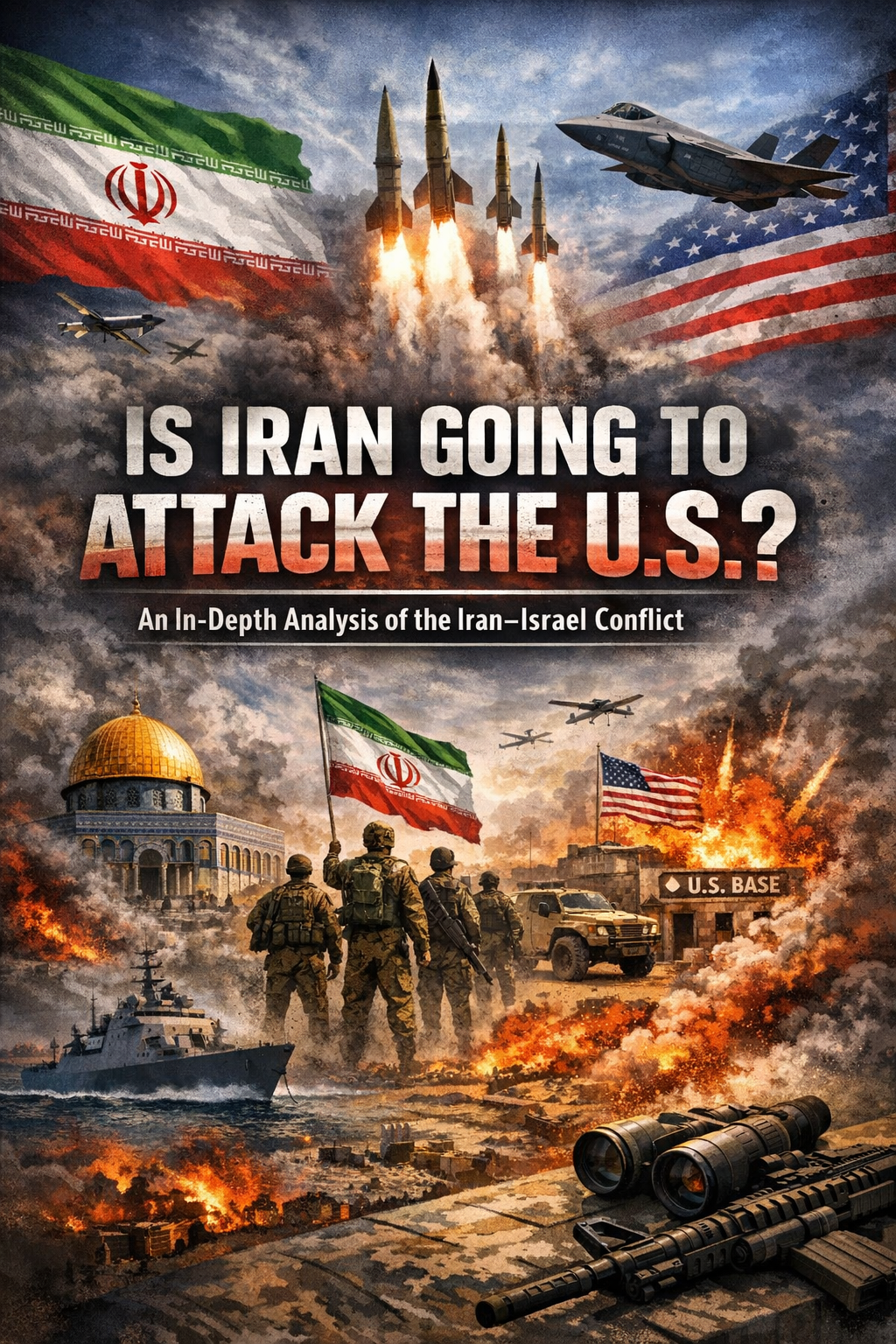
The Iran–Israel conflict has long been one of the most complex and volatile issues in the Middle East, with implications that reach far beyond the region. Over the decades, the rivalry has evolved from political tensions to proxy wars, cyber confrontations, and direct military threats. In early 2026, the situation escalated sharply, raising global concern over potential wider conflict. One pressing question on international minds is: is Iran going to attack the U.S? While most immediate tensions are focused on Israel, Iran’s broader regional ambitions and rhetoric toward Western powers, particularly the United States, make this question both urgent and complex.
The recent escalation in 2026 is unprecedented. With large-scale airstrikes, missile attacks, and drone warfare becoming more frequent, global leaders are closely monitoring the situation. The possibility of Iran targeting U.S. assets—directly or indirectly—cannot be ignored, especially given historical hostilities and Iran’s strategic capabilities.
Historical Background
Relations between Iran and Israel took a dramatic turn following the 1979 Iranian Revolution. Before the revolution, Iran maintained a relatively cooperative relationship with Israel, based on pragmatic geopolitical and economic interests. However, the establishment of the Islamic Republic transformed Iran’s foreign policy, emphasizing ideological opposition to Israel and support for the Palestinian cause.
Since then, the two countries have experienced decades of hostility. Iran has consistently positioned itself as a leading opponent of Israel in the region, supporting proxy groups such as Hezbollah in Lebanon and Hamas in Gaza. Israel, in turn, has developed advanced intelligence operations and a robust defense strategy aimed at neutralizing threats emanating from Iran and its allies. Over the years, cyber conflicts, covert operations, and skirmishes along regional borders have underscored the depth of their enmity.
Major Causes of the Conflict
Several key factors underpin the ongoing conflict between Iran and Israel:
Iran’s Nuclear Program
Iran’s nuclear ambitions have been a central point of international concern. Israel views a nuclear-capable Iran as an existential threat, prompting calls for strict sanctions and, in some circles, preemptive military action.
Israel’s Security Fears
Israel’s defense policy revolves around early warning systems and rapid retaliation. With Iran’s missile development programs and support for regional militias, Israel perceives a continuous security risk requiring proactive measures.
Political and Ideological Differences
Ideological opposition remains a core driver of tension. Iran’s revolutionary principles include opposition to Israel’s legitimacy, while Israel maintains a policy of defending its sovereignty against perceived regional adversaries.
Influence in the Middle East
Both countries seek to expand their influence. Iran leverages proxy groups and political alliances to strengthen its position, while Israel invests in diplomatic and military strategies to counterbalance Iranian influence.
Proxy Groups and Regional Alliances
Iran’s support for armed groups in Lebanon, Syria, and Gaza has often drawn Israeli retaliation, creating a cycle of attacks and counterattacks that heightens regional instability.
Events Leading to the 2026 Escalation
Tensions steadily increased in the years leading to 2026. Both nations engaged in military exercises, drone surveillance, and warnings of retaliation for minor attacks. Diplomatic channels struggled to maintain dialogue, and repeated international efforts failed to produce lasting solutions. The accumulation of military provocations and strategic posturing ultimately led to open confrontation in early 2026.
Beginning of the War in February 2026
By late February 2026, the situation escalated into a full-scale conflict. Israel launched large-scale airstrikes targeting Iranian military facilities in Syria, missile production sites, and strategic infrastructure. Iran responded with missile launches and drone incursions aimed at Israeli cities and military installations. The rapid escalation underscored the fragile nature of regional security and the potential risks of wider confrontation.
Military Actions Between Iran and Israel
Missile Attacks
Iran deployed medium- and long-range missiles against military bases and logistical hubs in Israel, while Israel retaliated with precision strikes on Iranian installations in Syria and Iraq.
Drone Warfare
Both sides increasingly relied on unmanned aerial vehicles for reconnaissance and attacks. Israeli drones targeted Iranian supply lines, while Iranian drones attempted to disrupt Israeli airspace.
Airstrikes
Air power played a crucial role in the conflict. Israel’s advanced air force conducted surgical strikes to minimize civilian casualties while maximizing strategic impact. Iran, though less technologically advanced, used airstrikes supported by proxy forces to demonstrate its reach.
Defense Systems
Israel activated the Iron Dome and David’s Sling missile defense systems to intercept incoming threats. Iran fortified key military sites with anti-aircraft systems and underground facilities to reduce vulnerability.
Retaliation and Strategic Targets
The conflict remained focused on military objectives, but both sides also struck logistical networks, ports, and energy infrastructure to weaken the adversary’s capacity for prolonged engagement.
Role of Other Countries
The United States
The U.S. played a dual role: providing military and intelligence support to Israel while warning Iran against attacking American interests. Washington’s involvement fueled speculation over whether Iran might extend its attacks to U.S. bases or allies.
Regional Countries
Neighboring countries monitored the conflict closely, with some supporting Israel diplomatically and others backing Iran indirectly. The shifting alliances heightened uncertainty across the Middle East.
International Organizations
The United Nations and global powers called for restraint and ceasefire negotiations. Humanitarian agencies warned of civilian risks and sought to facilitate aid to affected regions.
Impact on Civilians and Cities
Civilians in both Israel and Iran faced severe consequences. Airstrikes and missile attacks damaged residential areas, schools, and hospitals. Thousands were injured, and emergency services struggled to respond. Public fear and uncertainty disrupted daily life, with many citizens seeking shelter and basic necessities.
Economic and Global Impact
The conflict immediately affected global oil markets, given Iran’s role as a major oil producer. International trade faced disruption, particularly in shipping lanes near the Persian Gulf. Political instability in the Middle East reverberated worldwide, raising concerns about long-term economic consequences.
International Reactions
Global leaders reacted with a mix of concern and condemnation. Diplomatic efforts intensified, with calls for ceasefires, mediation, and conflict resolution. The risk of escalation prompted coordinated efforts by multiple countries to prevent a broader regional war.
Current Situation (March 2026)
As of March 2026, military activity continues, though at a somewhat reduced intensity due to targeted ceasefire negotiations. Diplomatic efforts are ongoing, with international mediators attempting to create a framework for sustainable peace. Both Iran and Israel remain vigilant, and the potential for renewed escalation remains high.
Possible Future Outcomes
Risk of Further Escalation
The conflict could widen if either side feels existentially threatened. There is also the potential for Iran to target U.S. assets indirectly, raising global security concerns.
Potential Regional War
Neighboring countries could be drawn into hostilities, either directly or through proxy groups, increasing the risk of a broader Middle Eastern conflict.
Diplomatic Solutions
Negotiations remain the most viable path to de-escalation. International pressure, combined with regional mediation, may create conditions for a lasting truce.
Long-Term Effects
Even if the conflict subsides, tensions between Iran and Israel are unlikely to disappear. The impact on regional stability, trade, and civilian life could persist for years.
Conclusion
The Iran–Israel conflict in early 2026 has brought renewed global attention to longstanding tensions. While the immediate conflict is concentrated in the Middle East, the question of is Iran going to attack the U.S remains relevant due to Iran’s historical rhetoric and military capabilities. Diplomacy, international engagement, and cautious military planning are crucial to preventing further escalation. As the world watches closely, the priority remains clear: maintaining peace, protecting civilians, and ensuring global stability in one of the most volatile regions on the planet.