
I still remember the day I confidently told a client, “Your business falls under retail.”
They looked at me, paused, and said, “We’re actually in SaaS.”
Awkward.
That moment made me realize I didn’t fully understand business vertical classification categories—and how important they are. Since then, I’ve spent a lot of time learning, testing, and even messing up a few times along the way.
So if you’ve ever been confused about where your business fits, you’re not alone. Let me break it down in a simple, real-world way.
What Are Business Vertical Classification Categories?
In plain English, business vertical classification categories are ways to group businesses based on the industry or niche they operate in.
Think of it like organizing apps on your phone.
You wouldn’t put your camera app in the “Games” folder, right?
Same idea here.
These categories help:
-
Identify your target market
-
Streamline marketing strategies
-
Improve SEO and visibility
-
Make partnerships easier
In short, they help you make sense of your business in the bigger picture.
Why Getting Your Business Vertical Right Matters
I used to think this was just a “corporate labeling” thing. But I learned the hard way that it actually impacts everything.
Here’s what changed when I got it right:
-
My content started attracting the right audience
-
My ads became more effective (and cheaper)
-
Networking became easier because I knew who to approach
Personal Tip #1:
When I finally aligned my business with the correct vertical, my website traffic improved within weeks. Not because I worked harder—but because I worked smarter.
Common Business Vertical Classification Categories
Let’s walk through the most common ones you’ll come across.
1. Retail
This is where I mistakenly placed that client earlier.
Retail includes businesses that sell products directly to consumers.
Examples:
-
Clothing stores
-
Online shops (eCommerce)
-
Supermarkets
If you’re selling physical products, chances are you’re in retail.
2. Technology (Tech / SaaS)
This is where my client actually belonged.
Tech businesses provide software, platforms, or IT services.
Examples:
-
SaaS platforms
-
Mobile apps
-
Web development services
This vertical is huge and constantly evolving.
3. Healthcare
This category includes anything related to health and wellness.
Examples:
-
Hospitals and clinics
-
Fitness centers
-
Mental health services
Even wellness blogs can fall into this vertical depending on their focus.
4. Finance
Anything involving money management fits here.
Examples:
-
Banks
-
Investment firms
-
Insurance companies
If your business deals with financial transactions or advice, this is your space.
5. Education
This one is more diverse than people think.
Examples:
-
Schools and universities
-
Online courses
-
Coaching services
I once worked with a client who thought they were in “marketing,” but they were actually in the education vertical because they sold courses.
6. Hospitality & Travel
If your business focuses on experiences, this might be your category.
Examples:
-
Hotels
-
Travel agencies
-
Restaurants
7. Manufacturing
This includes businesses that produce goods.
Examples:
-
Factories
-
Product manufacturers
-
Industrial production companies
8. Real Estate
Anything related to property buying, selling, or renting.
Examples:
-
Property dealers
-
Rental services
-
Construction firms
Horizontal vs Vertical: A Quick Reality Check
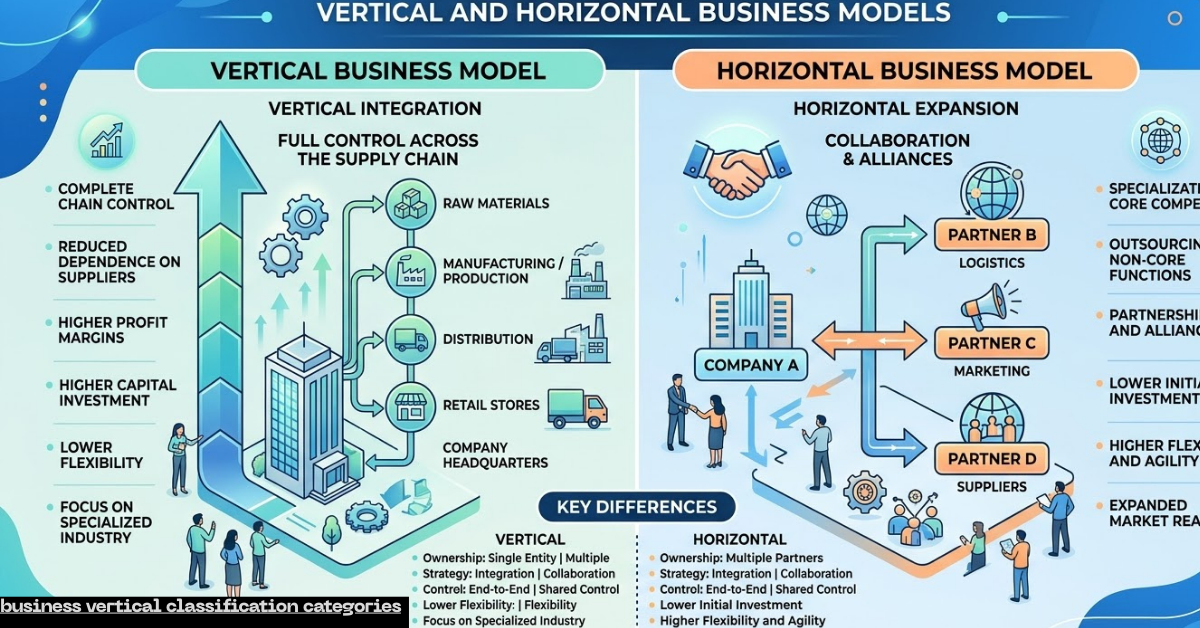
This confused me for the longest time.
-
Vertical business = Focuses on a specific industry
-
Horizontal business = Serves multiple industries
For example:
-
A CRM designed only for real estate = vertical
-
A general CRM used by everyone = horizontal
Understanding this helped me position my services much better.
How to Identify Your Business Vertical (Step-by-Step)
If you’re still unsure where your business fits, try this simple method I personally use:
Step 1: Ask What You Offer
Is it a product, service, or experience?
Step 2: Identify Your Audience
Who benefits from it?
Step 3: Look at Industry Standards
Search competitors and see how they classify themselves.
Step 4: Narrow It Down
Choose the category that best aligns—not the one that sounds better.
Personal Tip #2:
Don’t try to fit into a “trendy” vertical just because it’s popular. I tried positioning myself in tech once—it didn’t work because my audience wasn’t there.
Related Keywords You Should Know
While learning about business vertical classification categories, I came across a few terms that helped me understand things better:
-
Industry classification
-
Market segmentation
-
Business niche categories
-
Vertical markets
-
Sector classification
These are often used interchangeably, but they all point to the same core idea.
Mistakes I Made (So You Don’t Have To)
Let me save you some trouble.
Choosing a Broad Category
I once labeled a business as “technology” when it was clearly “EdTech.” That lack of clarity hurt targeting.
Ignoring Audience Behavior
Your category should match where your audience spends time, not just what you think sounds right.
Not Updating Over Time
Businesses evolve. Your classification should too.
How Business Vertical Classification Helps SEO
This was a game-changer for me.
Once I aligned my content with the right vertical:
-
My keywords became more relevant
-
My blog started ranking faster
-
My bounce rate dropped
Search engines love clarity. When your vertical is clear, your content becomes easier to categorize and rank.
Final Thoughts on Business Vertical Classification Categories
Looking back, I used to think this topic was overly technical and honestly a bit boring. But now I see it differently. Understanding business vertical classification categories isn’t just about labels—it’s about clarity.
-
Who you serve
-
What you offer
-
How you grow
Once you get that right, everything else becomes easier.