
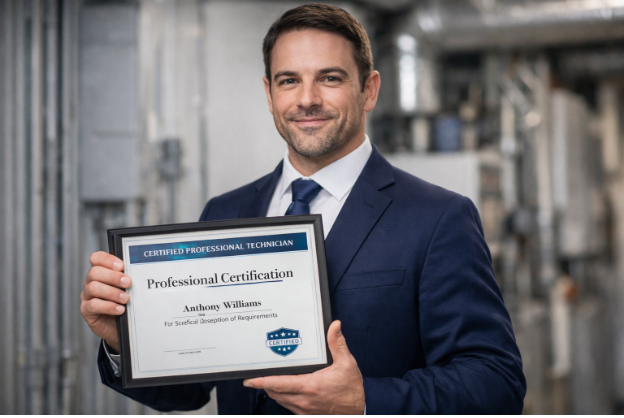
Most people assume the path to earning more money involves one of three things: asking for a raise, switching employers, or getting promoted. All three work, sometimes. But they all depend on someone else saying yes—your boss, a hiring manager, a promotion committee. There is a fourth option that depends entirely on you, costs a fraction of a degree, and delivers a wage premium that shows up in federal data year after year: earn a professional certification.
It is not glamorous advice. Nobody is going to make a TikTok about it. But the numbers are genuinely hard to argue with.
The 16 Per Cent Premium
The Bureau of Labor Statistics has tracked a persistent wage gap between certified and uncertified workers: roughly 16 per cent more for those holding a professional licence or certification, controlling for occupation and education. In the UK, PwC’s 2025 Global Workforce Hopes and Fears Survey found that 54 per cent of workers had learned career-relevant skills in the previous twelve months—and those who formalised their learning with a verifiable credential reported higher confidence in their career trajectory.
Sixteen per cent does not sound dramatic until you do the arithmetic. On a £35,000 salary, that premium is £5,600 per year. Over five years, it compounds to £28,000 in additional earnings—from a credential that typically costs a few hundred pounds and takes three to six months of part-time study. Compare that return to almost any other investment available to a working adult, and the maths is not close.
Why Certifications Work Where Degrees Don’t
A university degree proves you studied a subject for three or four years. A professional certification proves you can do a specific job to a verified standard right now. For employers filling roles that need to be staffed immediately—in healthcare, construction, technology, education, financial services—the distinction matters enormously.
Certifications are also portable in ways that degrees often are not. A certified project manager is recognised globally. A licensed EMT can work in any state. A credentialled safety supervisor carries a qualification that means the same thing regardless of which university they attended—or whether they attended one at all. For a generation that changes jobs every one to two years and frequently crosses borders for work, that portability is not a luxury. It is a requirement.
The Gen Z Catalyst
The generational data adds urgency to the trend. CVwizard’s 2025 research found that 66 per cent of Gen Z and 65 per cent of Millennials are planning to change jobs this year. When asked what is holding them back, 47 per cent pointed to re-skilling and education as their biggest obstacle. They want to move. They know they need new skills. The barrier is not ambition—it is access to a credentialing pathway that is fast, affordable, and valued by employers.
Professional certification exams are standardised, proctored, and designed to verify genuine competence. Candidates who prepare effectively—using structured resources like test prep to familiarise themselves with exam formats and identify knowledge gaps—pass at higher rates and reach the earnings increase sooner. Every failed attempt costs time and retest fees, which means preparation is not just an academic strategy. It is a financial one.
Which Certifications Pay Back Fastest
The credentials with the quickest return on investment share a common profile: they are tied to regulated industries where the credential is legally required or strongly preferred, the training period is short relative to the pay increase, and labour demand for credential holders outstrips supply. In healthcare, phlebotomy and EMT certifications open immediate doors. In technology, cloud certifications from Microsoft and AWS routinely add £5,000 to £15,000 to annual salaries. In construction, safety credentials like the OSHA 30 or the Construction Health and Safety Technician designation command premium day rates.
The pattern is consistent across industries: the faster the certification, the cheaper the cost, and the more regulated the field, the faster the payback.
The Investment Nobody Talks About
Personal finance advice is full of recommendations about index funds, emergency savings, and compound interest. All sound. But the single highest-returning investment most working adults can make is not in a brokerage account. It is in their own professional credentials. A certification is a one-time cost that generates recurring returns for as long as you work in that field. Unlike a stock, the return is not subject to market sentiment. It is a function of supply, demand, and demonstrated competence. In a 2026 job market where those three forces are all moving in the same direction, that combination is extraordinarily hard to beat.