
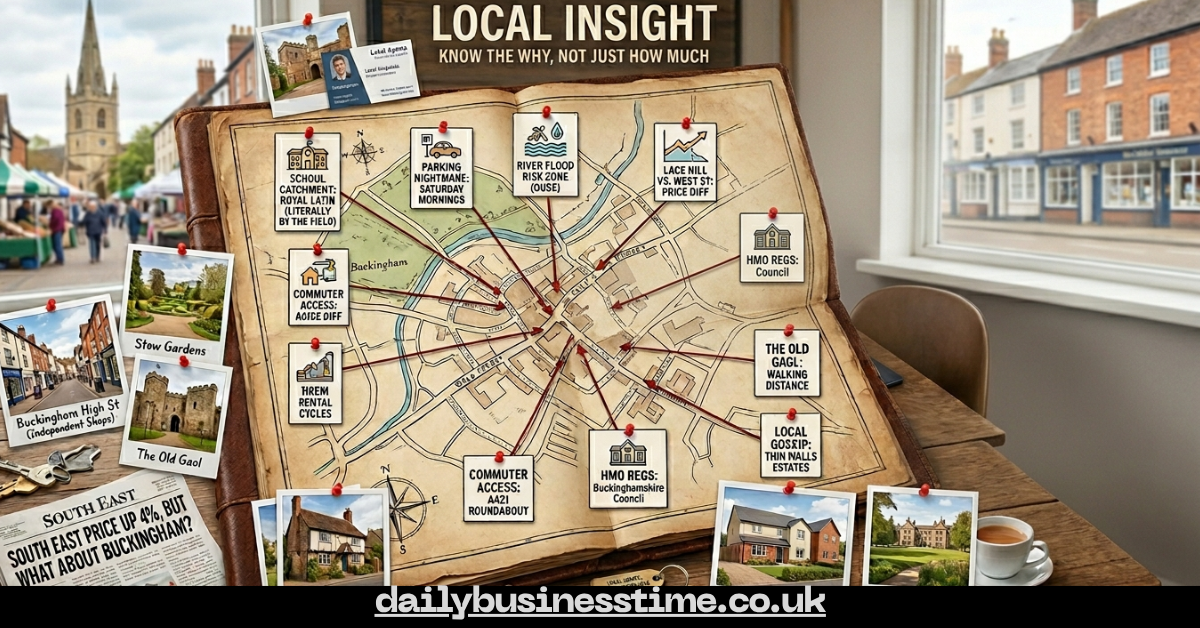
Look, if you’ve ever tried to navigate a property move, you know the sinking feeling of realizing the generic advice you read online doesn’t apply to the street you’re actually standing on. It’s frustrating. You see headlines about national house price averages or broad regional trends, but those numbers are useless when you’re trying to figure out why a house on West Street is valued differently from one in the Lace Hill development. Buckingham is a market town with a very specific, almost stubborn, sense of identity. It doesn’t just follow the lead of London or even Milton Keynes. It has its own rhythm, its own bottlenecks, and its own unique set of “unwritten rules.” To get it right, you need more than just data—you need someone who knows exactly which roads get flooded by the Great River Ouse and where the parking nightmare begins on a Saturday morning. Working with local estate agents in Buckingham gives you that boots-on-the-ground reality that a spreadsheet just can’t capture. It’s about knowing the “why” behind the prices, not just the “how much.”
The Buckingham Bubble: Why Generic Data Fails
I’ve seen it happen dozens of times. A seller looks at a national portal, sees that property values in the South East are “up by 4%,” and assumes their three-bed semi in Buckingham is now worth a tidy bit more. But here’s the thing: Buckingham exists in a bit of a bubble. Because it’s a historic market town with limited space for new expansion within the historic core, the supply-and-demand dynamic is incredibly skewed. You aren’t just competing with other sellers in the county; you’re dealing with a very specific pool of buyers who want the “Buckingham Life”—the independent shops, the historic charm, and the proximity to Stowe.
When you rely on a non-local perspective, you miss the nuance of the school run. In Buckingham, the catchment area for the Royal Latin School or the local primary schools like Buckingham Primary can literally change the value of a house by five figures, even if the properties are only a few hundred yards apart. A national algorithm doesn’t understand that. It doesn’t know that being within walking distance of the Old Gaol is a massive selling point for a specific demographic, while others would pay a premium to be far enough away from the town centre traffic. Local experts don’t just look at the house; they look at the life that happens around it. They know which estates have better drainage, which ones have “thin walls” according to the local gossip, and which streets are currently seeing a surge in interest from young families moving out of more expensive hubs.
Furthermore, the physical reality of Buckingham’s housing stock is diverse, ranging from medieval foundations to modern sustainable builds. If you’re looking at a period property on Well Street or Castle Street, you aren’t just buying a home; you’re taking on a piece of history that comes with its own set of quirks—listed status, damp risks common to the area, or specific maintenance requirements that only a local surveyor or agent would be familiar with. Without that local lens, you’re essentially flying blind. You might think you’re getting a bargain, only to find out later that the local community has been campaigning against a specific development nearby for months. Local expertise is your early warning system. It’s the difference between making a solid investment and inheriting a headache.
The University Effect and the Rental Chess Match
If you’re looking at the rental side of things, Buckingham is an even more specialized beast. Most people forget—or don’t realize the impact of—the University of Buckingham. It’s unique. It’s the UK’s first independent university with a royal charter, and its two-year degree structure means the student population turns over differently than in traditional university towns. This creates a rental market that is fast-paced and, frankly, quite lucrative if you know how to play it. But it’s a chess match. You have to balance the needs of students who want to be close to the Hunter Street or Verney Park campuses with the needs of local professionals and families who are looking for long-term stability.
A landlord coming in from outside the area might see a high yield on paper but won’t understand the vacancy risks associated with the university’s specific term dates. Local property experts understand this timing. They know exactly when to list a property to catch the next wave of postgraduates and which areas are preferred by the international student community. They also know which parts of town are becoming “family zones” where HMOs (Houses in Multiple Occupation) might be less welcome or subject to stricter local council regulations. Buckinghamshire Council has its own way of doing things, and since the shift to a unitary authority, keeping up with local planning and licensing changes requires constant attention.
It’s not just about the students, though. The “commuter’s compromise” is a huge factor here. People work in Milton Keynes, Aylesbury, or even London, but they want to sleep in Buckingham. They’re looking for a specific type of rental property—usually something with parking (which is gold dust in the town centre) and good access to the A421. If you’re a tenant, finding these gems before they’re snapped up requires being “on the list” of a local agent who knows what’s coming up before it even hits the web. In a market this tight, the best properties often don’t even make it to the major portals. They’re let to the person who the agent called ten minutes after the previous tenant gave notice. That’s the power of local connection.
Beyond the Listing: The Reality of Living Local
Let’s be honest: property photos are meant to deceive. They use wide-angle lenses to make a box-room look like a ballroom and edit out the fact that the “garden” is actually a concrete strip next to a noisy bypass. When you’re buying or renting in a town you don’t know intimately, you’re at the mercy of the marketing. This is where the local expert becomes your most valuable asset. They can tell you, “Yes, it looks great, but that road is a nightmare at 8:30 AM when everyone is trying to get onto the Stratford Road,” or “The garden is lovely, but you’ll hear the secondary school bell every day.”
This kind of “radical honesty” only comes from people who value their local reputation. A local agent lives in the community. They see their clients at the Saturday market or in Waitrose. They can’t afford to sell someone a “dream home” that turns out to be a local notorious lemon. They’ll tell you about the smell of the river in a heatwave, the difficulty of getting a GP appointment at the local surgery, or the fact that a certain pub nearby has a very loud karaoke night on Thursdays. It sounds like small stuff, but it’s the small stuff that makes you love or hate where you live.
And then there’s the negotiation. Buckingham is a “word of mouth” town. Local agents talk to each other. They know which solicitors are fast and which ones are currently drowning in paperwork. They know if a seller is in a genuine rush to move or if they’re just testing the water. When you have a local expert in your corner, you’re not just a name on a contract; you have someone who can navigate the local social and professional networks to keep a chain together when things get rocky. I’ve seen chains saved simply because the two local agents involved could sit down and have a frank conversation about a survey result that would have scared off a non-local buyer. They knew the house, they knew the problem, and they knew it was fixable because they’d seen it three doors down the previous year.
The Final Word on Moving Smart
At the end of the day, moving house is one of the most expensive and stressful things you will ever do. Why would you do it based on “average” information? Buckingham isn’t an average town. It’s a place with a high street that has survived the rise of the internet, a community that turns out in droves for the Christmas parade, and a property market that rewards those who take the time to understand its quirks. The “more than ever” part of this topic is real—as the world becomes more digital and more generic, the value of the person who actually knows the names of the neighbours and the history of the house goes up.
So, if you’re thinking about making a move, stop looking at the national heat maps. They won’t tell you about the charm of a morning walk by the river or the specific frustration of the A421 roundabout. Instead, lean on the people who are there every day. They’re the ones who can tell you if that “great investment” is actually a money pit, or if that “slightly overpriced” cottage is actually a once-in-a-decade opportunity. In a town like Buckingham, expertise isn’t just a service—it’s your safety net. Don’t settle for the general when you can have the local. It’s a choice you won’t regret when you’re finally settled in, listening to the church bells and knowing you’re exactly where you’re supposed to be.