
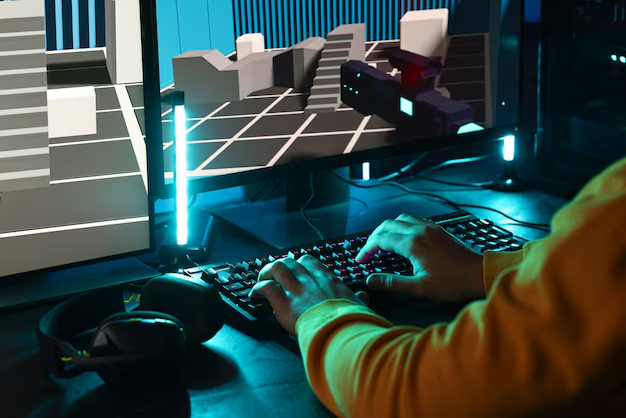
Independent game creation is experiencing a revolution unlike any before. Once defined by scarcity of resources, long development cycles, and limited access to advanced tools, indie development has evolved into a playground of creativity. The arrival of new, intuitive platforms is removing barriers that once separated dreamers from makers. In this new era, imagination holds more power than technical skill, and small teams are producing experiences that rival major studios.
From Code-Heavy Development to Creative Freedom
Not so long ago, creating a game meant months of learning complex programming languages or building engines from scratch. This technical wall kept many creative thinkers from ever turning their concepts into playable realities. Today, however, accessible tools are shifting the balance. Developers can now focus on what makes their games meaningful: worlds, mechanics, and stories, while technology takes care of the heavy lifting in the background.
Instead of worrying about optimization or compatibility, creators are now free to refine artistic direction and player experience. This freedom is not just simplifying development; it’s changing what indie studios aim for. Games built by one or two people can now carry the same polish, emotion, and depth as titles from big-budget teams.
The Rise of Tools That Empower Imagination
Modern creation platforms are no longer just instruments of production; they’re creative partners. Builders can visualize entire environments, animate characters, and script mechanics through intuitive systems that make creation feel more like play. These tools guide developers rather than command them, providing flexibility without restricting innovation.
Astrocade exemplifies this evolution in game development with AI tools. Its design mirrors how today’s developers think: fast, iterative, and community-driven. By offering visual systems that simplify complex processes, Astrocade frees creators from technical headaches so they can concentrate on refining gameplay and story flow. It acts as a digital workshop where experimentation thrives, and creative ideas take shape swiftly.
A Shift in Creative Power
This movement has quietly redistributed creative power within the gaming landscape. Previously, studios with budgets could afford multiple specialists, artists, engineers, sound designers, and testers. Independent creators often had to fill all those roles alone, which limited scope and production value. Now, with supportive tools that manage much of the technical overhead, indie producers can invest their time where it counts most, crafting emotional depth, unique visual aesthetics, and gameplay originality.
It’s a profound change not only for developers but for players as well. Audiences are discovering a wider variety of voices, ideas, and cultural influences in games. Titles that were once passion projects for a few friends can now reach global audiences, competing in artistry and quality with more established releases. The boundaries between amateur and professional continue to blur, and that diversity enriches the entire ecosystem.
Community as the New Studio
One of the most powerful shifts in this modern era is how communities function as living, breathing studios. Feedback loops are faster than ever; creators can share builds, gather thoughts, tweak designs, and redeploy updates all within days. Platforms like Astrocade support these dynamics naturally, offering seamless collaboration environments where ideas move freely.
Collaboration no longer demands office space or physical meetings. Global partnerships arise organically as developers connect across time zones, sharing vision documents, art assets, and prototypes. The creative process becomes open-ended, interactive, and deeply social. This community-first approach encourages diversity of thought and experimentation without the pressure of commercial risk.
Game Creativity Without Fear of Failure
What makes this new wave of game creation remarkable is its ability to reduce fear. Traditional development often involved high costs and long timelines; mistakes could be disastrous. Modern tools make experimentation inexpensive and iterative. Developers can test mechanics quickly, analyze what works, and adjust before full-scale investment.
That freedom to fail opens the door to bolder creative risks. More niche storylines, unconventional genres, and artistic experiments are thriving because creators can afford to push boundaries without starting over from scratch. This has inspired an explosion of new game types, from meditative puzzle experiences to short narrative journeys that explore emotion and identity.
The Democratization of Storytelling
Storytelling, once reserved for teams with narrative designers and scriptwriters, is now accessible to anyone with a story to tell. The latest generation of creation platforms, such as Monster Brawl, encourages visual storytelling through simple yet powerful elements, including behavior logic, dialogue builders, and environment tools. Even first-time creators can craft immersive experiences that convey their message through gameplay alone, rather than relying solely on cutscenes.
Prompt-based game development with an AI approach aligns perfectly with this trend. Its framework simplifies how creators develop their worlds and stories while still supporting complexity when needed. This balance between simplicity and depth fuels creativity rather than stifling it, allowing developers to express culture, emotion, and imagination with less restriction.
The Future of Indie Creativity
The next chapter for independent game making will continue to blur traditional lines, between player and creator, art and technology, individual and collective effort. No-code game creation Tools will push this transformation forward by integrating collaboration, accessibility, and community connection into every part of the creative pipeline.
What lies ahead is not just more games but a richer, more inclusive creative culture. As technology continues to simplify the intricate parts of design and coding, storytelling and artistry become central again. The question is no longer “Can I make this?” but rather “What do I want to express?”
Independent developers are stepping into an era where their ideas matter more than their resources. The playing field continues to level, creating a dynamic landscape filled with originality, diversity, and personal vision. This redefinition of how games are created ensures that creativity from every corner of the world has a chance to shine.
A New Definition of Independence
Ultimately, independence in development now means not working alone but working freel, free from outdated limitations, free from fear of failure, and free to imagine worlds that reflect human experience in all its variety. With an empowering AI game creation tool leading the charge, the future belongs to creators who dare to dream and share their voices through interactive art.
The transformation is not simply about making development easier; it’s about restoring the soul of creation itself. For indie developers everywhere, this is more than a shift in process; it is the dawn of a creative renaissance.